Manage your risk exposure continuously
Identify your assets, detect vulnerabilities, and manage remediation from a single platform. Cyberwatch centralizes your security data to help you reduce risk and act faster.
Map
Build a dynamic, continuous inventory of all your assets.
A reliable, up-to-date inventory is the foundation of attack surface management. Cyberwatch automatically discovers your assets across all perimeters and integrates them into a centralized, continuously updated inventory.
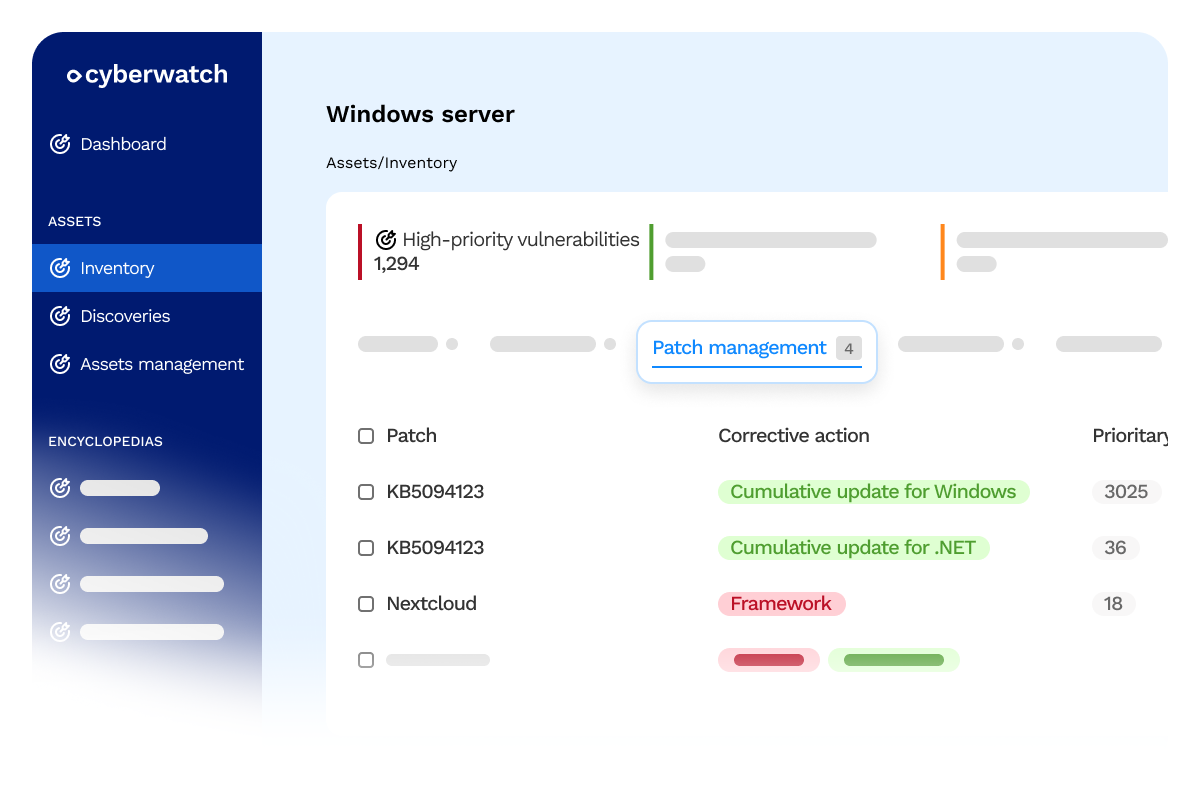
Architecture, installation, and operations documentation, along with procedures tailored to your environment.
Covered perimeters
- On-premise infrastructure: Servers, workstations, VMs, hypervisors. Network scans and targeted discovery, agent-based or agentless integration
- Cloud (AWS, Azure, GCP, OpenStack): Automatic inventory via cloud provider APIs. Multi-project, multi-region coverage
- Containers & Kubernetes: Container images (registries and deployed), EKS/AKS/OpenShift clusters
- External surface: WHOIS, DNS enumeration, Certificate Transparency, public IP scans
- Identities: Active Directory, Microsoft 365, Entra ID
- OT / Industrial: Rockwell, Schneider, Siemens, and SNMP connectors, air-gap mode
- Software libraries: SCA for npm, yarn, Maven, Composer, pip, NuGet, RubyGems, and Go
Scoping
- Organize your assets into projects and groups aligned with your business priorities (Production, DMZ, Dev, etc.)
- Define rules by perimeter: scan frequency, alert thresholds, access rights, and CID criticality
- Restrict access to your assets by team and group your assets dynamically
Detect
Detect all exposures: vulnerabilities, non-compliance, and misconfigurations.
Exposure goes beyond just CVEs. Cyberwatch detects software vulnerabilities, compliance gaps, misconfigurations, and identity weaknesses across all your perimeters, continuously.
Architecture, installation, operations, and procedure documentation tailored to your environment.
Vulnerabilities (CVE)
- Proprietary agent-based or agentless scans, air-gapped mode
- Comprehensive CVE database and exploit kits, hosted on-premises or via SaaS
- Authenticated scans to reduce false positives
- Learn more about Vulnerability Manager →
Compliance and configurations
- Continuous audit of CIS Benchmarks, ANSSI, CERT-FR, and custom frameworks
- Cloud compliance control (AWS, Azure, GCP)
- Active Directory and Microsoft 365 audit (privileged accounts, GPO, delegations, PKI)
- Learn more about compliance management →
External surface (DAST / EASM)
- OWASP scans, attack simulation (SQL injection, XSS, Log4Shell), and SSL/TLS verification
- Technology fingerprinting, open port detection, and exposed services
- Learn more about EASM →
DevSecOps
- SCA (Software Composition Analysis), EOL component detection, container image scanning, SBOM generation
- En savoir plus sur le DevSecOps →
Prioritize
Move from raw CVE volume to the actual risk exploitable in your context.
Prioritization is not based on CVSS scores alone. Cyberwatch cross-references the actual context of your assets, the likelihood of exploitation, and alerts from your trusted authorities to transform thousands of vulnerabilities into a short, actionable queue of tasks.
Architecture, installation, operations, and procedure documentation tailored to your environment.
we combine:
Contextual CVSS-BTE score
CVSS recalculation based on CIA (Confidentiality, Integrity, Availability) requirements and the network exposure of each asset
Exploit Prediction Scoring System (EPSS)
Factoring in the probability of vulnerability exploitability within 30 days.
Public exploits
Detection of vulnerabilities for which an exploit kit is available
Alerts from trusted authorities
CERT-FR ALE, CISA-KEV, European national CERTs, your company's CERT
Business criticality of the asset
Internet exposure rank, operational role, hardening level
Decide
Validate the reality of threats and measure the effectiveness of your actions.
Before mobilizing your teams, confirm that the risk is real in your specific context and verify that your patches have effectively eliminated the exposure. The validation phase turns theoretical decisions into measurable risk reduction.
Architecture, installation, operational, and procedural documentation tailored to your environment.
Enriched vulnerability encyclopedia
For each CVE: CVSS/CVSS-BTE severity, available patches, known public exploits, and active attack kits
Automatic post-remediation re-scanning
Verification that the CVE has been successfully remediated following a patch deployment or configuration change
Calculating exposure time (MTTR)
Mean Time To Remediate: detection date → correction date, to measure your responsiveness and meet your SLAs.
Regression detection
Identification of vulnerabilities that have reappeared after patching, remediation failures, and configuration drift.
Remediate
Orchestrate remediation and drive risk reduction over time
Cyberwatch acts as the central hub connecting your security, IT, and management teams through a shared remediation plan.
Architecture, installation, operations, and procedure documentation tailored to your environment.
Technical remediation:
Integrated Patch Management
Deploy security patches on Linux and Windows directly from Cyberwatch, with dependency management
ITSM Integration
Automated, pre-filled tickets for ServiceNow, Jira, and GLPI with full context (asset, severity, recommended fix)
Quick wins
Identify the fixes that reduce your exposure the most with the fewest actions
Technical and management oversight:
Dashboards
Critical CVEs by perimeter, mean time to remediate, SLA compliance, scan coverage
Automated alerts
New critical CVE, obsolete system, missed remediation deadline
Management reports
Risk reduction tracking over time, NIS2/DORA/ISO 27001 compliance
MCP (Model Context Protocol) server
Connect Cyberwatch to any large language model (Claude, GPT, Mistral, Llama, etc.) to query your security data, generate analyses, and automate your workflows using natural language
Integrated data visualization module
Use the dashboards included directly in the software to visualize and analyze your vulnerability data without any external configuration
scope covered
Comprehensive coverage of your IT assets
Workstations
e.g. Linux, Windows, macOS, desktop and mobile
Servers
e.g. VMs, physical machines, hypervisors, mainframes
Cloud environments
e.g. AWS, Azure, GCP, Office 365
Containers
e.g., Docker, Kubernetes, Harbor, registries
Websites
e.g., URLs, IPs, APIs, OWASP, SSL/TLS
Network equipment
e.g., Cisco, Palo Alto, Fortinet, Stormshield
Industrial equipment
e.g., Siemens, Schneider, Rockwell, Wago
Identity directory
e.g., Active Directory, Entra ID
Software libraries
e.g. NPM, Maven, PyPI, NuGet, Go modules
Testimonials
The platform centralizes both our PCI compliance for online billing operations and our broader IT vulnerability management, which simplifies our security oversight.

CISO, energy
CISO

Quarterly ASV scans and the supplementary pentest provide us with a comprehensive view of our PCI DSS compliance, with reports that are directly actionable for our QSA auditors.
Payment Security Manager, Finance
Payment Security Manager
Hardening our configurations according to CIS Benchmarks allowed us to close entry points we hadn't even considered, all without interrupting our production.
Systems Administrator, industry
Systems and Network Administrator
Continuous auditing of our Active Directory revealed several poorly managed privileged accounts, which we were able to remediate quickly.
CISO, healthcare
CISO
Pouvoir déployer une console complète isolée d'Internet, avec mise à jour manuelle de la base de vulnérabilités, était un prérequis pour certains de nos environnements les plus critiques.
Exemple à remplacer — Responsable sécurité, secteur public
Responsable sécurité des systèmes d'information
Le mode air-gap totalement déconnecté correspond exactement à nos exigences de sécurité pour les systèmes les plus sensibles, sans compromis sur la qualité de la détection.
Exemple à remplacer — Responsable SSI, défense
Responsable de la sécurité des systèmes d'information
Le suivi de notre conformité NIS2 est désormais centralisé et actualisé en continu, ce qui simplifie considérablement nos rapports aux autorités compétentes.
Exemple à remplacer — RSSI, énergie
RSSI
La génération automatisée de preuves d'audit nous fait gagner un temps précieux lors de nos revues de conformité DORA et de nos échanges avec nos auditeurs.
Exemple à remplacer — Responsable conformité, finance
Responsable conformité
La formation Cyberwatch Certified Professional a permis à nos équipes de monter en compétence rapidement et d'exploiter pleinement les fonctionnalités de remédiation de la plateforme.
Exemple à remplacer — Responsable IT, industrie
Responsable infrastructure IT
Le patch management intégré et les tickets générés automatiquement dans notre outil ITSM ont nettement réduit nos délais de correction.
Exemple à remplacer — DSI, secteur public
DSI
Avec des centaines de dispositifs médicaux à surveiller, la priorisation par criticité métier nous permet de ne pas nous disperser tout en respectant la continuité des soins.
Exemple à remplacer — RSSI, santé
RSSI
Le scoring contextuel nous aide à concentrer nos équipes sur les vulnérabilités qui présentent un risque réel pour nos installations, plutôt que de traiter des milliers de CVE sans distinction.
Exemple à remplacer — Responsable cybersécurité, énergie
Responsable cybersécurité
Pouvoir cartographier nos environnements sensibles sans connexion réseau permanente était une exigence non négociable. Cyberwatch répond à cette contrainte tout en gardant un inventaire à jour.
Exemple à remplacer — Officier sécurité, défense
Officier de sécurité des systèmes d'information
La cartographie automatique de nos actifs nous a permis de découvrir des serveurs oubliés que nos audits précédents n'avaient jamais identifiés. C'est un vrai gain de visibilité sur notre Shadow IT.
Exemple à remplacer — Responsable sécurité, finance
Responsable sécurité IT
L'accompagnement de l'équipe Cyberwatch a été déterminant pour déployer la plateforme sur nos sites de production sans perturber nos lignes. Le support dédié répond vite et comprend nos contraintes industrielles.
Exemple à remplacer — DSI, industrie
DSI
Avec Cyberwatch, nous avons enfin une vue exhaustive de notre parc informatique et pouvons prioriser nos actions de remédiation selon un risque réel plutôt qu'une simple liste de CVE. La plateforme s'intègre bien à nos contraintes de souveraineté.
Exemple à remplacer — RSSI, secteur public
RSSI
FAQ
From asset mapping to automated remediation.
What is Continuous Threat Exposure Management (CTEM)?
Continuous Threat Exposure Management (CTEM) is a framework for managing cyber threat exposure, as defined by Gartner. It replaces one-off audits with a continuous cycle of asset discovery, vulnerability detection, prioritization, validation, and remediation. The goal is to consistently reduce actual risk rather than reacting to periodic scans that quickly become obsolete. It focuses on addressing the most critical, truly exploitable vulnerabilities for the organization first.
How does CTEM differ from traditional vulnerability management?
CTEM goes beyond traditional vulnerability management. The latter relies on periodic scans focused on detection and CVE criticality scores. CTEM adopts a risk-oriented approach focused on the continuous reduction of vulnerability exposure: it maps actual exposure, detects changes in the attack surface in real time, incorporates business context, prioritizes the remediation of the most likely threats, and validates the effectiveness of patches, rather than simply listing CVEs.
How does Cyberwatch prioritize which vulnerabilities to fix?
Cyberwatch goes beyond simple CVSS scores. The platform cross-references the business criticality of your assets with the actual probability of exploitation and alerts from trusted authorities. As a result, only 2% of identified exposures actually impact critical assets, allowing you to focus your remediation efforts where they matter most.
What perimeters does Cyberwatch cover?
Cyberwatch covers your entire attack surface: internal IT infrastructure (servers, Active Directory, Microsoft 365), industrial OT environments, cloud (AWS, Azure, Google Cloud), external surface (EASM, DAST), and DevSecOps (SCA, SBOM, container scanning). More than 50 native connectors provide centralized and continuous mapping of all your IT assets.
Why validate the effectiveness of a patch rather than simply deploying it?
Deploying a patch does not guarantee that the risk has been eliminated. It may be incorrectly applied, incomplete, incompatible with the environment, or only address part of the vulnerability. Validating its effectiveness ensures that the flaw is no longer exploitable, that the service remains functional, and that no regressions have been introduced. This step transforms a remediation action into a truly demonstrable risk reduction.
What are the tangible benefits for an organization that adopts CTEM?
Organizations that adopt CTEM gain continuous visibility into their actual exposure, moving beyond point-in-time scans. They can prioritize risks based on exploitability, business criticality, and likelihood of attack. This approach cuts through the noise of endless CVE backlogs, improves security team efficiency, and accelerates remediation. CTEM also makes it easier to measure risk reduction, align technical efforts with business objectives, and strengthen overall resilience.