
Penetration Testing (Pentest)
Simulate real-world attacks to reveal flaws before attackers do. Our cybersecurity experts assess the actual security level of your infrastructure, identify exploitable vulnerabilities, and guide you through the remediation process.
01
Pentest objectives
A real-world cyberattack simulation, conducted by cybersecurity experts, to identify exploitable flaws before attackers do.
Identify vulnerabilities
Detect technical flaws in your systems and applications before they are exploited.
Assess your security level
Measure your actual resilience against cyberattacks and test the effectiveness of your existing protections.
Prioritize patches
Rank vulnerabilities by criticality level to focus your efforts on the highest risks.
Reduce the attack surface
Minimize potential entry points for attackers and strengthen your security posture.
02
Types of pentests offered
Application (Web / API)
Vulnerability analysis of your websites, business applications, and exposed APIs.
Infrastructure
Security assessment of your IT environments: servers, networks, Active Directory, and Cloud.
Internal / External
Simulation of an internal attacker (malicious employee) or an external one (attacker from the Internet).
Red Team
Realistic attack simulation with defined objectives, combining social, physical, and digital techniques.

03
Three approaches based on your level of information
Black Box
The pentester has no prior information about the target. They act like a real external attacker, discovering your information system from scratch. This approach tests your actual exposure to an opportunistic threat.
Grey Box
The pentester has partial information: a user account, partial technical documentation, or limited access. This approach simulates an attacker who already has a foothold in your IS (e.g., a service provider or an employee with limited rights).
White Box
The pentester has full access: source code, network architecture, administrator accounts, and documentation. This approach allows for the most exhaustive analysis and identifies deep-seated vulnerabilities that are invisible from the outside.
04
Our 5-phase methodology
Based on recognized frameworks: NIST Cybersecurity Framework, PTES (Penetration Testing Execution Standard), and OWASP.
Scoping
Definition of scope, rules of engagement, business objectives, and legal constraints.
Reconnaissance
Passive and active information gathering. Footprinting, OSINT, and attack surface analysis.
Exploitation
Attempts to exploit identified vulnerabilities. Obtaining initial system access.
Analysis
Lateral movement, persistence, assessment of the value of obtained access, and impact analysis.
Report
Detailed report with remediation recommendations and a non-technical summary for management.
05
Deliverables
Actionable results that go beyond a simple report
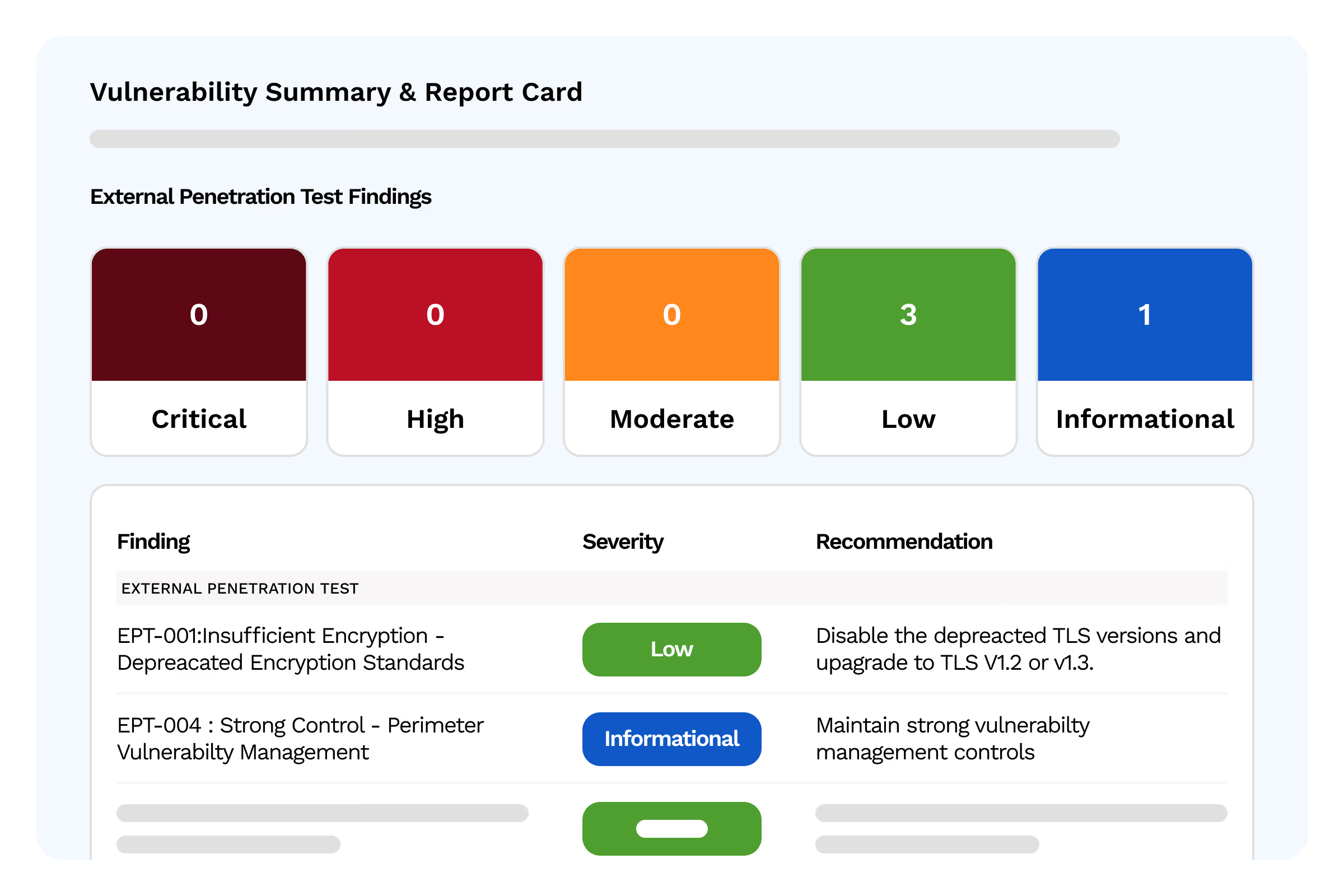
Detailed vulnerability report
Every discovered flaw with its criticality level, exploitation conditions, and technical evidence
- Item 1
- Item 2
- Item 3
Proof of Concept (PoC)
Technical demonstration of the actual exploitability of identified vulnerabilities
- Item 1
- Item 2
- Item 3
Risk prioritization
Ranking by impact and likelihood of exploitation to target the most urgent fixes
- Item 1
- Item 2
- Item 3
Remediation recommendations
Concrete, prioritized corrective actions that your teams can implement immediately
- Item 1
- Item 2
- Item 3
Executive summary
A non-technical summary for management, outlining the overall risk level and key actions to be taken
- Item 1
- Item 2
- Item 3
06
Why Cyberwatch?

Cybersecurity expertise
Over 10 years of experience in IT vulnerability management. A Framatome subsidiary since 2022.

Proven methodologies
NIST, PTES, and OWASP for reliable, reproducible results aligned with international standards.

Remediation-focused approach
Actionable recommendations, not just a report. We support you in implementing the necessary fixes.

Continuity with the platform
Pentest results feed directly into Cyberwatch for continuous monitoring of vulnerabilities and their remediation.
07
Value for your organization
A measurable investment to strengthen your security posture
Realistic vision
Get an objective assessment of your infrastructure's actual security level, going beyond automated scans
- Item 1
- Item 2
- Item 3
Continuous improvement
Enhance your cybersecurity posture over time through regular pentests and remediation tracking
- Item 1
- Item 2
- Item 3

Regulatory compliance
Meet the requirements of ISO 27001, NIS2, DORA, PCI-DSS, and other standards mandating regular penetration testing
- Item 1
- Item 2
- Item 3
Data protection
Protect your company's critical data and systems by identifying exploitable attack paths
- Item 1
- Item 2
- Item 3
08
Combine pentesting and EASM
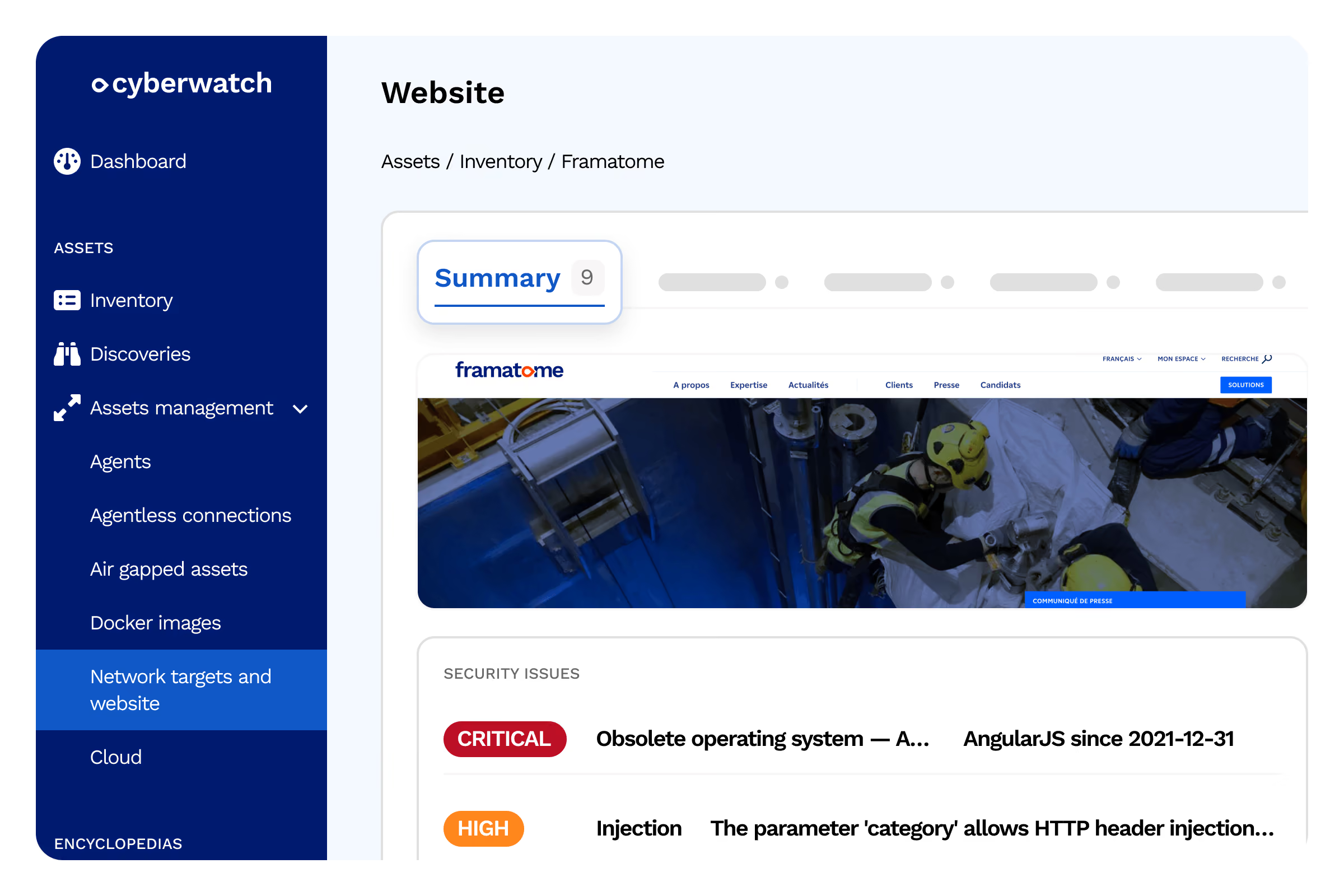
EASM continuously monitors your attack surface. Pentesting validates the exploitability of vulnerabilities.
Our penetration tests are a natural complement to our EASM (External Attack Surface Management) solution. EASM maps and monitors your external attack surface 24/7. Pentesting manually validates the exploitability of the most critical flaws discovered and identifies logical vulnerabilities that only human expertise can reveal.
Testimonials
The platform centralizes both our PCI compliance for online billing operations and our broader IT vulnerability management, which simplifies our security oversight.

CISO, energy
CISO

Quarterly ASV scans and the supplementary pentest provide us with a comprehensive view of our PCI DSS compliance, with reports that are directly actionable for our QSA auditors.
Payment Security Manager, Finance
Payment Security Manager
Hardening our configurations according to CIS Benchmarks allowed us to close entry points we hadn't even considered, all without interrupting our production.
Systems Administrator, industry
Systems and Network Administrator
Continuous auditing of our Active Directory revealed several poorly managed privileged accounts, which we were able to remediate quickly.
CISO, healthcare
CISO
Pouvoir déployer une console complète isolée d'Internet, avec mise à jour manuelle de la base de vulnérabilités, était un prérequis pour certains de nos environnements les plus critiques.
Exemple à remplacer — Responsable sécurité, secteur public
Responsable sécurité des systèmes d'information
Le mode air-gap totalement déconnecté correspond exactement à nos exigences de sécurité pour les systèmes les plus sensibles, sans compromis sur la qualité de la détection.
Exemple à remplacer — Responsable SSI, défense
Responsable de la sécurité des systèmes d'information
Le suivi de notre conformité NIS2 est désormais centralisé et actualisé en continu, ce qui simplifie considérablement nos rapports aux autorités compétentes.
Exemple à remplacer — RSSI, énergie
RSSI
La génération automatisée de preuves d'audit nous fait gagner un temps précieux lors de nos revues de conformité DORA et de nos échanges avec nos auditeurs.
Exemple à remplacer — Responsable conformité, finance
Responsable conformité
La formation Cyberwatch Certified Professional a permis à nos équipes de monter en compétence rapidement et d'exploiter pleinement les fonctionnalités de remédiation de la plateforme.
Exemple à remplacer — Responsable IT, industrie
Responsable infrastructure IT
Le patch management intégré et les tickets générés automatiquement dans notre outil ITSM ont nettement réduit nos délais de correction.
Exemple à remplacer — DSI, secteur public
DSI
Avec des centaines de dispositifs médicaux à surveiller, la priorisation par criticité métier nous permet de ne pas nous disperser tout en respectant la continuité des soins.
Exemple à remplacer — RSSI, santé
RSSI
Le scoring contextuel nous aide à concentrer nos équipes sur les vulnérabilités qui présentent un risque réel pour nos installations, plutôt que de traiter des milliers de CVE sans distinction.
Exemple à remplacer — Responsable cybersécurité, énergie
Responsable cybersécurité
Pouvoir cartographier nos environnements sensibles sans connexion réseau permanente était une exigence non négociable. Cyberwatch répond à cette contrainte tout en gardant un inventaire à jour.
Exemple à remplacer — Officier sécurité, défense
Officier de sécurité des systèmes d'information
La cartographie automatique de nos actifs nous a permis de découvrir des serveurs oubliés que nos audits précédents n'avaient jamais identifiés. C'est un vrai gain de visibilité sur notre Shadow IT.
Exemple à remplacer — Responsable sécurité, finance
Responsable sécurité IT
L'accompagnement de l'équipe Cyberwatch a été déterminant pour déployer la plateforme sur nos sites de production sans perturber nos lignes. Le support dédié répond vite et comprend nos contraintes industrielles.
Exemple à remplacer — DSI, industrie
DSI
Avec Cyberwatch, nous avons enfin une vue exhaustive de notre parc informatique et pouvons prioriser nos actions de remédiation selon un risque réel plutôt qu'une simple liste de CVE. La plateforme s'intègre bien à nos contraintes de souveraineté.
Exemple à remplacer — RSSI, secteur public
RSSI
FAQ
From asset mapping to automated remediation.
What is a pentest and what is it used for?
A pentest (penetration test) is a simulated cyberattack conducted by cybersecurity experts to identify exploitable vulnerabilities in your information system. Unlike an automated scan, it replicates the real-world techniques of an attacker to concretely assess your security level and prioritize fixes before a vulnerability is actually exploited.
What is the difference between black-box, grey-box, and white-box pentesting?
These approaches define the level of information provided to the pentesters. In a black-box test, they have no internal information. They take the position of an external attacker and discover the target on their own. In a grey-box test, they have partial information: user accounts, limited documentation, partial architecture, or a specified scope. In a white-box test, they have full access to technical information: source code, architecture, accounts, configurations, or detailed documentation.
How long does a penetration test take?
The duration varies depending on the scope and type of pentest, typically ranging from one to three weeks. A targeted application pentest can be completed in a few days, while a full infrastructure audit requires several weeks, including the scoping and definition phase, test execution, report writing, debriefing, and retesting after vulnerability remediation, if included in the contract.
What is the difference between a pentest and a vulnerability scan?
A vulnerability scan is an automated analysis that identifies known flaws in systems, applications, or networks without exploiting them. It primarily provides a checklist of items to review. A pentest is a more in-depth assessment, conducted by an expert, that attempts to exploit these flaws to measure their actual impact. The scan detects potential risks, while the pentest validates attack scenarios, exploitation paths, and business consequences.
What is the deliverable for a penetration test?
The primary deliverable of a penetration test is a detailed report outlining identified vulnerabilities, their criticality levels, proof of exploitation, potential impacts, and remediation recommendations. It often includes an executive summary for decision-makers, a technical section for IT teams, and a prioritized remediation plan. An oral presentation and a re-testing report may also be provided as part of the deliverable.
Pentesting and EASM: do you have to choose between them?
No, these approaches are complementary. EASM continuously monitors your external attack surface and exposure level (domains, subdomains, exposed services, certificates, configuration errors, forgotten assets, or new entry points). Pentesting, on the other hand, confirms the actual exploitability of critical flaws and reveals logical vulnerabilities that no automated tool can detect. The most effective approach is to use EASM for continuous visibility and pentesting for targeted, in-depth technical validation.