
Think you have your cybersecurity under control because you manage your internal infrastructure? That’s a good start, but it’s far from enough!
According to a recent study, approximately 79% of cyber risks actually lie outside your internal IT perimeter, particularly on the Internet (cloud services, exposed APIs, outsourced infrastructure, etc.).
A massive blind spot that keeps growing. And one that represents countless potential entry points for cybercriminals.
So how do you regain control? That is the whole point of EASM (External Attack Surface Management), an approach dedicated to managing your external attack surface.
Find out what it involves, why it has become essential, and how Cyberwatch helps you map, analyze, and monitor your external attack surface.
What is External Attack Surface Management (EASM)?
Definition and key principles
EASM is a cybersecurity approach that involves continuously identifying, analyzing, and monitoring all of an organization's digital assets exposed on the Internet, in order to secure them before a potential malicious actor can exploit them.
The principle is simple: adopt the attacker's perspective.
In practical terms, this involves scanning the internet to detect everything visible and accessible under your organization's name—such as misconfigured servers, expired certificates, and open APIs—and then proactively remediating these vulnerabilities.
What does an organization's external attack surface cover?
The external attack surface corresponds to all the digital exposure points through which your organization is visible (and potentially vulnerable) from the internet. This includes:
- Domains and subdomains: corporate websites, client portals, extranets, testing and staging environments, marketing microsites, and domains that have been acquired or abandoned but remain active…
- Exposed servers and infrastructure: web servers, VPNs, remote access gateways, jump servers, security appliances…
- Cloud services and outsourced environments: cloud instances, public storage, misconfigured SaaS services, exposed buckets, and IaaS or PaaS environments left open by default…
- APIs and application services: public APIs, unauthenticated endpoints, and business services exposed for partner or mobile integrations…
- Accessible network ports and services: obsolete protocols, unnecessary services left open, and exposed administration interfaces…
- Certificates, identities, and technical dependencies: expired, misconfigured, or compromised certificates, vulnerable software dependencies, and unmaintained technical components…
The external attack surface therefore encompasses a multitude of assets that are often dispersed, sometimes poorly documented, and frequently forgotten.
Why EASM is essential to organizational cybersecurity strategies
An approach backed by analysts and market recognition
The concept of External Attack Surface Management (EASM) was introduced by Gartner in 2021 in its report Hype Cycle for Security Operations. The following year, the analyst firm placed EASM in the "Innovation Trigger" category, anticipating gradual adoption over 5 to 10 years and highlighting the need for organizations to develop new skills to fully leverage these approaches.
However, the reality on the ground has significantly accelerated this trajectory.
In 2024, Gartner already confirms EASM as a pillar of modern cybersecurity.
EASM is now fully integrated into the Continuous Threat Exposure Management (CTEM) framework recommended by Gartner. It serves as the foundational building block: before you can manage threats, you must first know exactly what is exposed.
Adoption accelerated by the explosion of the external attack surface
If EASM has established itself so quickly in cybersecurity strategies, it is primarily because organizational information systems have changed profoundly. In just a few years, the external attack surface has expanded significantly due to several major developments:
- The cloud has multiplied points of exposure: SaaS services, AWS, Azure, or GCP instances, and environments created on the fly, often without centralized inventory.
- Remote work has opened up new critical access points: urgently deployed VPNs, exposed business applications, and expanded remote access.
- Shadow IT still evades the control of security teams: cloud tools used by business units, marketing subdomains, and unlisted collaborative platforms.
The result: a shifting, fragmented attack surface that is difficult to map… and riddled with blind spots. This is precisely the operational gap that EASM fills.
The tangible benefits of EASM
Finally, the success of EASM within organizations is explained by its tangible and immediately measurable benefits:
- Complete visibility into your actual exposure: you identify all your assets visible on the Internet, including those that were forgotten or unknown.
- Proactive risk reduction: you detect and fix vulnerabilities before they can be exploited.
- Improved regulatory compliance: you can more easily meet the requirements of NIS2, DORA, ISO 27001, and other frameworks.
Organizations that have adopted EASM strengthen their security posture and gain resilience.
EASM in practice
The 3 key steps of EASM
EASM relies on a continuous three-step operational cycle:
- Discovery: EASM tools scan the internet just as an attacker would to identify all exposed assets: domains, subdomains, IP addresses, network services, certificates, cloud instances, APIs, forgotten environments, or Shadow IT.
- Risk analysis and assessment: Each asset is analyzed to detect exploitable flaws: misconfigurations, obsolete software, known vulnerabilities, unnecessarily open ports, and exposed administration interfaces. Risks are qualified and prioritized based on their actual impact.
- Continuous monitoring: the attack surface is constantly evolving. EASM monitors changes, detects new exposures, and alerts you in real time as soon as any drift occurs.
These three steps function in a loop: it is this dynamic and continuous approach that distinguishes EASM from a one-off audit or a simple vulnerability scan.
Tools for managing your external attack surface
EASM is a comprehensive approach that combines processes, technologies, and services. But in practice, technology forms its operational foundation. Without a platform capable of observing the internet at scale, automatically mapping your assets, and continuously analyzing your exposure, it is simply impossible to master your external attack surface.
Modern EASM solutions rely on dedicated platforms, generally deployed in SaaS mode for rapid implementation and extensive coverage, or on-premises to meet the strictest security, compliance, and sovereignty requirements.
However, not all EASM platforms are created equal; their effectiveness depends directly on the depth of discovery, the quality of analysis, and the ability to prioritize risks.
This is precisely where Cyberwatch positions itself, our platform for vulnerability management and compliance management, which natively integrates External Attack Surface Management capabilities.
How Cyberwatch helps you master your external attack surface
Automatically map your exposed assets
Cyberwatch relies on a powerful discovery engine (asset discovery), capable of automatically identifying your organization's assets that are accessible via the Internet.
The identified assets are then integrated into a centralized inventory, allowing them to be monitored, analyzed, and tracked over time.
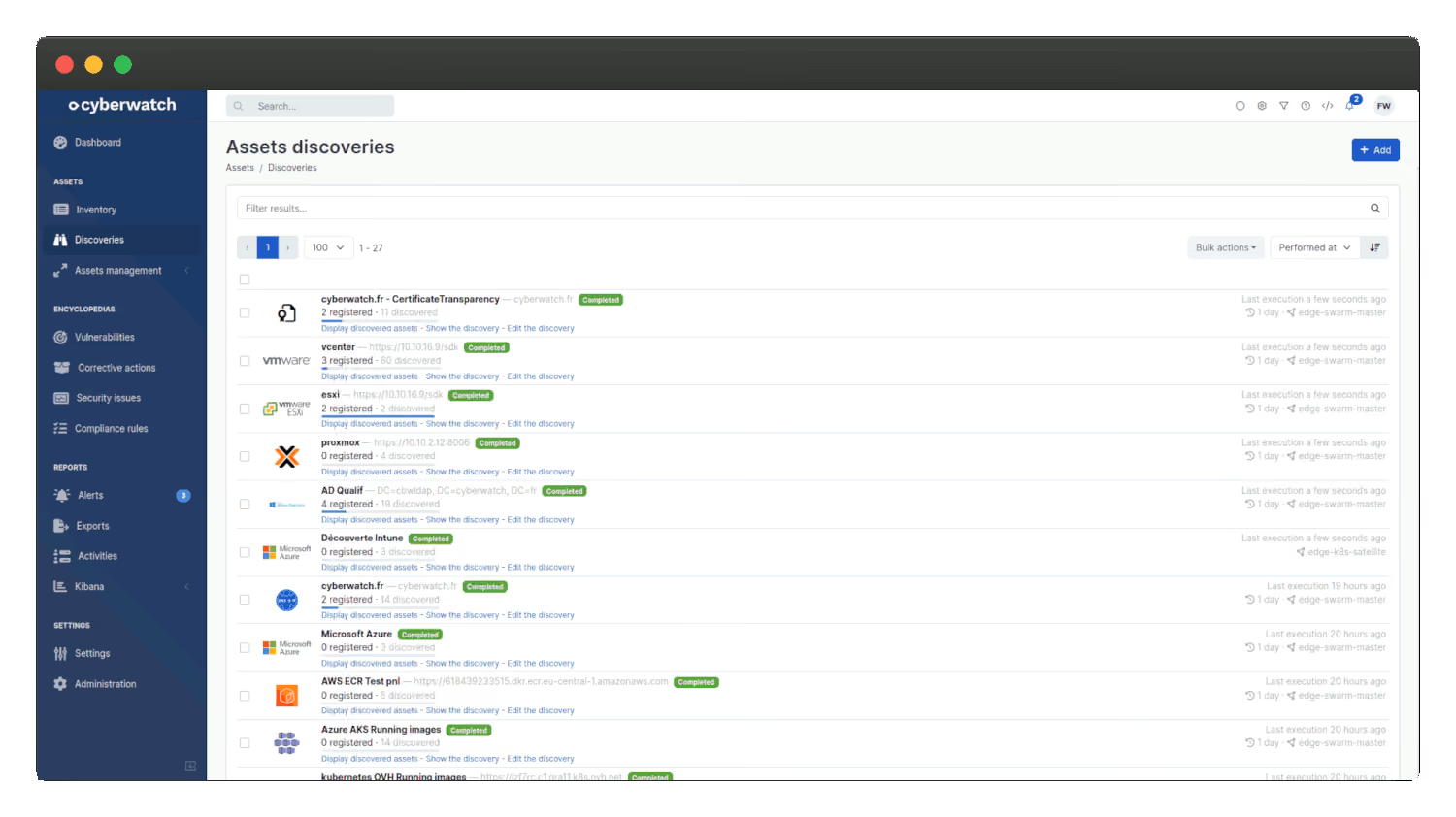
To build this map, Cyberwatch uses several complementary methods:
Mapping of domain names and subdomains
Cyberwatch implements several identification techniques:
- WHOIS discovery : analyzing domain name registration databases makes it possible to identify domains belonging to the organization, its subsidiaries, or its service providers. This step serves as the starting point for the reference perimeter.
- DNS enumeration discovery: once domains are identified, Cyberwatch automatically searches for associated subdomains (e.g., www, api, admin, dev). This method maps web interfaces and their related services.
- The Certificate Transparency discoveries : Cyberwatch queries public TLS certificate issuance logs to identify subdomains for which an HTTPS certificate has been issued. The presence of a certificate indicates an intent for public exposure and helps validate the actual exposure of services.
Combining these three approaches provides comprehensive coverage of your domain namespace. This multi-source correlation also allows you to prioritize security checks on assets whose exposure is confirmed by multiple indicators.
Cloud infrastructure mapping
Cyberwatch also offers several identification mechanisms to inventory resources present on cloud infrastructures:
- AWS (notably EC2)
- Microsoft Azure
- Google Cloud Platform
- OpenStack
By directly querying the APIs of these platforms, the solution automatically inventories instances, virtual machines, public IP addresses, and other active resources.
This approach addresses a major challenge: multi-cloud environments, often managed by multiple teams, facilitate a loss of traceability and the proliferation of shadow IT.
Cloud discoveries thus make it possible to detect these assets before they become attack vectors, and to prioritize security controls on resources actually exposed to the Internet.
Public network range mapping
Finally, Cyberwatch allows you to identify machines accessible on public IP address ranges (datacenters, cloud environments, subsidiaries, hosting providers) using network scans (Nmap).
This step establishes a real map of the external network perimeter and provides a reliable view of hosts accessible from the Internet.
Analyze your attack surface and identify entry points
Once assets are discovered, Cyberwatch allows you to analyze their actual exposure and identify potential entry points for an attacker.
Network and web scans allow you to:
- Confirm that a service is active and responding
- Identify which ports are open
- Determine which services are running on an IP or subdomain
- Detect the technologies being used
- Identify visible configuration flaws
This surface analysis helps distinguish between a theoretical asset and a truly exploitable entry point, allowing you to focus your checks on resources that are actually accessible from the Internet.
Manage your attack surface with dashboards and reports
Cyberwatch provides dashboards and reporting modules that allow you to track the evolution of your external attack surface over time.
The platform allows you to:
- Generate an export of the list of discovered assets (Cloud, DNS, WHOIS, Certificate Transparency, networks),
- Visualize the most vulnerable assets or those that do not comply with security best practices,
- Track exposure trends using summary indicators.
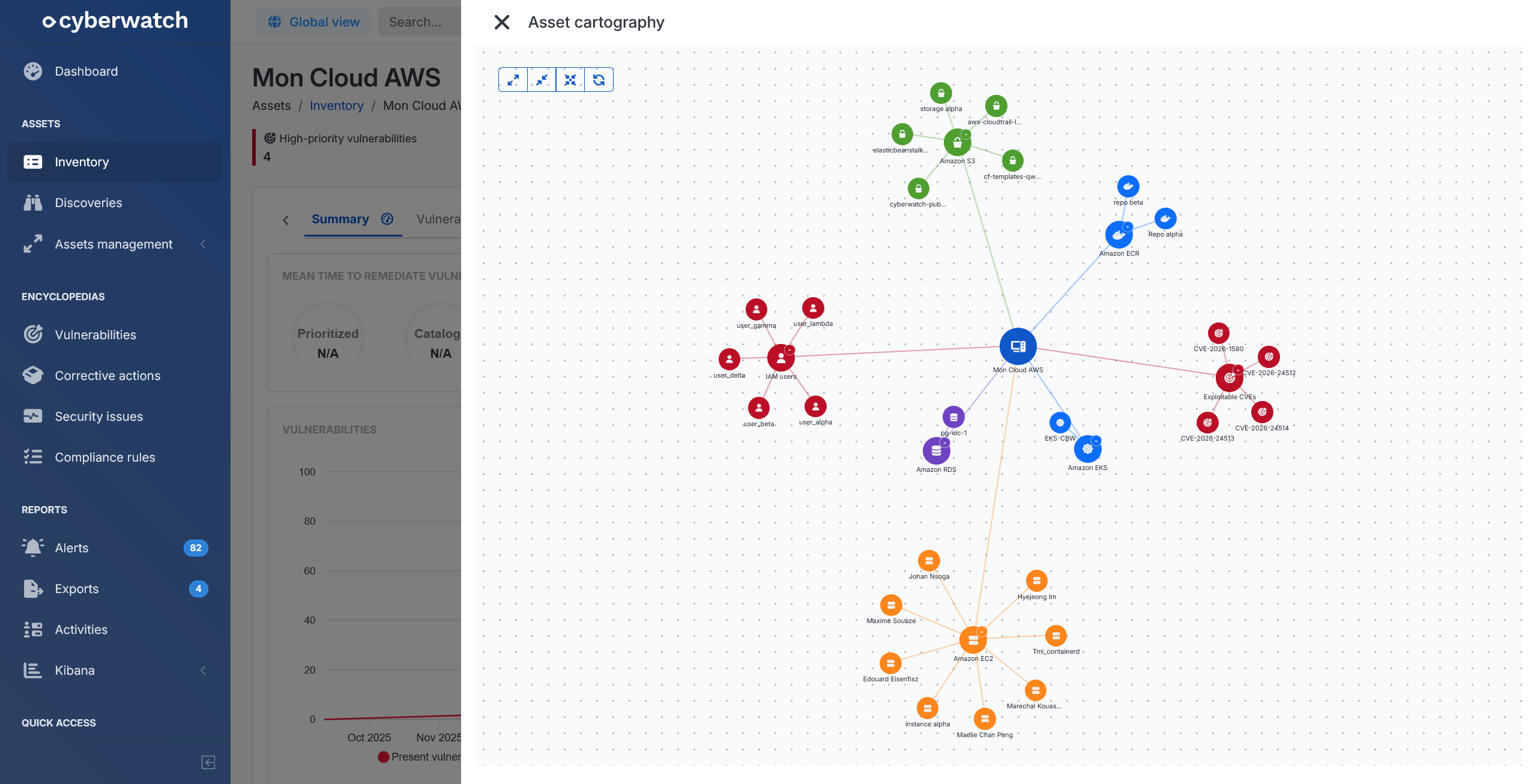
Visual maps also allow you to graphically represent exposed assets, open ports, vulnerabilities (CVEs), hosted web services, and their associated discovery sources.
Prioritize your vulnerabilities based on your actual exposure context
Identifying vulnerabilities is not enough. The challenge is knowing which ones pose a real risk.
That is why Cyberwatch helps you prioritize your vulnerabilities based on your exposure context and the criticality of your assets, so you can focus your remediation efforts where they have the most impact.
The platform allows you to:
- Assess the business and technical criticality of your assets,
- Define prioritization rules tailored to your environment,
- Highlight vulnerabilities exploitable from public networks as a priority.
You thus shift from volumetric vulnerability management to a risk-driven approach, based on actual exposure and attack scenarios.
Integrate your EASM strategy into a comprehensive CTEM framework
To go further and move beyond simple attack surface mapping, Cyberwatch allows you to integrate your EASM strategy into the CTEM (Continuous Threat Exposure Management) framework with:
- Compliance monitoring for publicly accessible cloud platforms
- OWASP scans for exposed websites and servers
- Authenticated application scans to identify software installed on exposed servers
- Advanced prioritization mechanisms based on asset criticality and network exposure
These capabilities allow you to precisely qualify risks, limit Shadow IT, and prioritize vulnerabilities that are actually exploitable from public networks.
Key takeaways
79% of cyber risks lie outside your internal perimeter. EASM allows you to regain control by automatically identifying all your assets exposed on the Internet (forgotten domains, cloud services, open APIs), detecting exploitable flaws, and monitoring changes continuously.
With Cyberwatch, you turn this visibility into concrete action: automatic mapping, real risk analysis, intelligent prioritization based on your exposure context, and long-term management via dedicated dashboards.
Request a free demo and finally identify your true areas of exposure on the Internet!
FAQ
What is the difference between EASM and traditional vulnerability management?
EASM adopts an attacker's perspective by scanning the internet to discover all your exposed assets (including those you aren't aware of), whereas traditional vulnerability management focuses on scanning your internal infrastructure that has already been inventoried.
Is EASM only for large enterprises?
No. Any organization with an internet presence can benefit from it. SMEs, which often have limited security teams, particularly benefit from automating what their teams cannot monitor manually.
Does EASM replace penetration testing?
No, these approaches are complementary. EASM provides continuous, automated monitoring of your exposures, while penetration tests provide periodic validation of the actual exploitability of vulnerabilities.
What is the difference between EASM and CTEM?
EASM focuses on discovering and monitoring your external attack surface. CTEM is a broader framework that encompasses EASM and adds internal threat management, exploitability validation, and continuous effectiveness measurement.